Market indicators
Why Bitcoin dominance can rise as its price falls
A worked example of Bitcoin’s share of the crypto market and what changes the denominator.
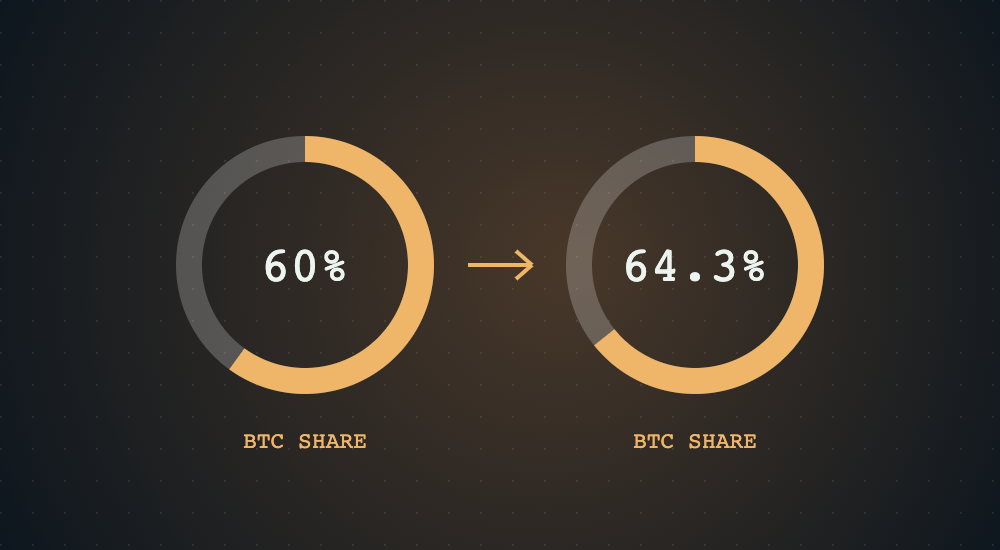
Bitcoin dominance expresses Bitcoin’s market capitalization as a percentage of the total crypto market capitalization tracked by a data provider. There are two moving parts. A change in the percentage can come from Bitcoin, from the rest of the market, or from both.
Work through a falling market
Imagine Bitcoin has a market cap of $600 billion and all other tracked assets together account for $400 billion. Bitcoin’s share is 60%. Now suppose Bitcoin’s market cap falls to $540 billion while the rest falls to $300 billion. Divide 540 by the new total of 840 and Bitcoin’s share is roughly 64.3%.
Bitcoin lost 10% of its market value in this example. Its share grew because the rest of the market shrank faster.
Compare like with like
Start with two observations from the same provider. Note Bitcoin’s market cap, the total and the timestamp at each observation. Subtract Bitcoin’s market cap from the total to see what happened to the rest. This also helps explain the reverse case, where Bitcoin gains value while its share falls.
Bring the comparison back to sectors
The remaining market includes many assets that can move in different directions. After checking dominance, look at sector performance over the same interval to see which groups rose or fell together. A single dominance reading cannot identify those groups.
Explore the underlying metrics in CoinGecko’s methodology.