Market fundamentals
What does crypto market cap measure?
Use price and circulating supply to compare two tokens with very different unit prices.
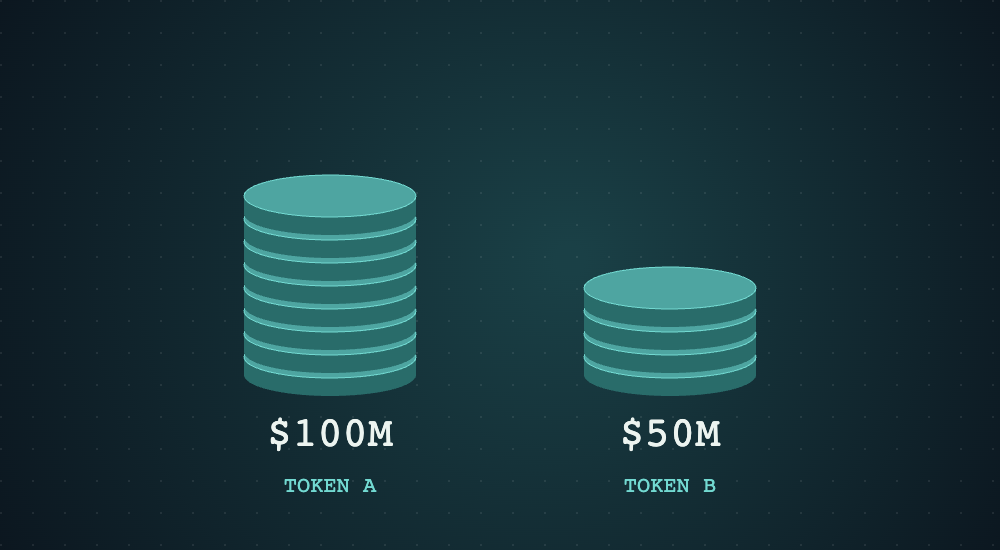
A token priced at ten cents can have a larger market capitalization than a token priced at ten dollars. The missing piece is how many units circulate. Multiply the current price per token by the circulating supply to estimate the market value of that supply.
Compare two hypothetical tokens
Token A trades at $0.10 and has one billion tokens in circulation. Its market cap is $100 million. Token B trades at $10 with five million tokens circulating. Its market cap is $50 million. Buying a single unit of B costs one hundred times as much, yet A has twice the market cap.
Why a price move changes the whole figure
If A rises from $0.10 to $0.11 while its circulating supply stays fixed, its market cap rises to $110 million. The calculation applies the new price to all one billion circulating tokens. The $10 million increase alone tells you nothing about the amount of cash buyers spent.
Read the supply label
Circulating supply can change as tokens unlock or are removed from circulation. When comparing figures, check which supply estimate each provider uses and when it was updated. A fully diluted valuation uses a different supply assumption, so placing it beside a circulating market cap can distort the comparison.
For details on pricing and supply estimates, see CoinGecko’s methodology.